Key Takeaways
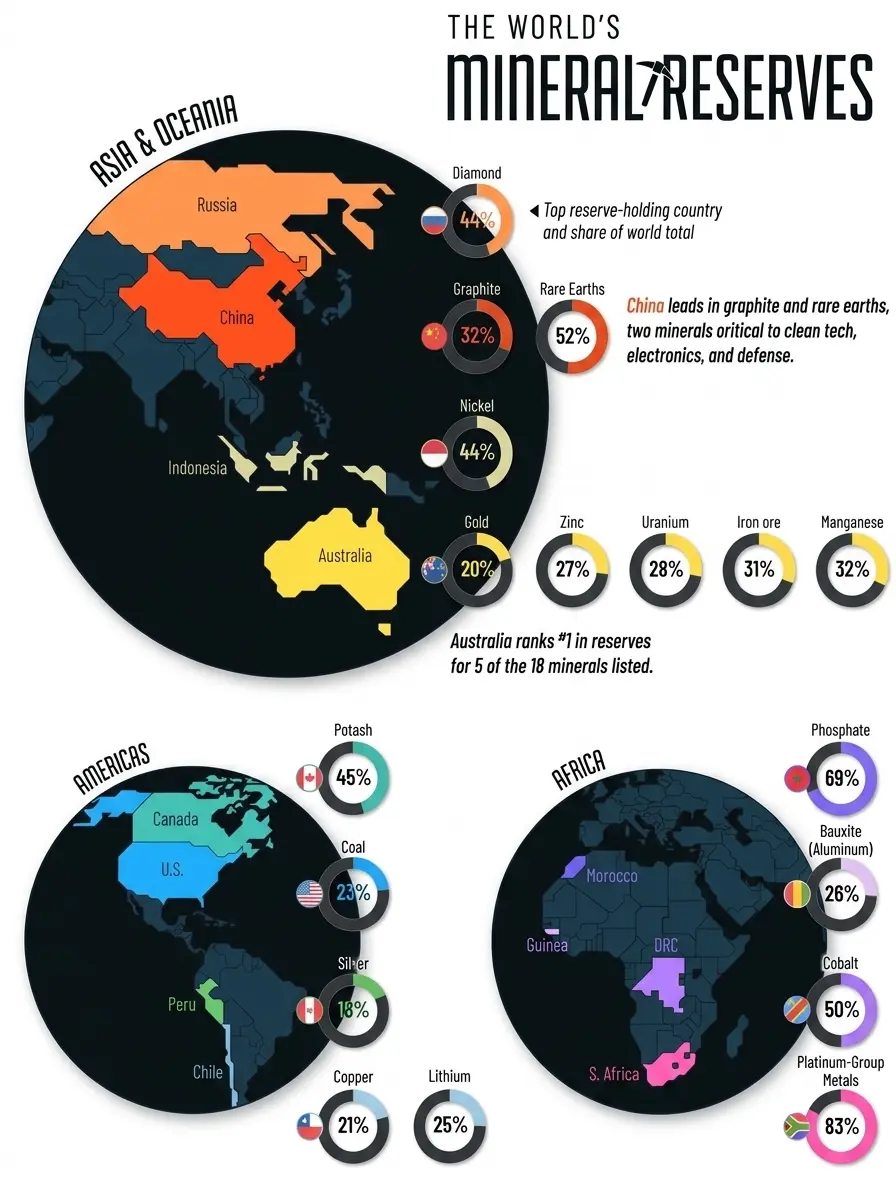
- Australia holds the largest reserves of five major minerals, more than any other country in the dataset.
- China leads in rare earths and graphite reserves, giving it a major position in several strategic supply chains.
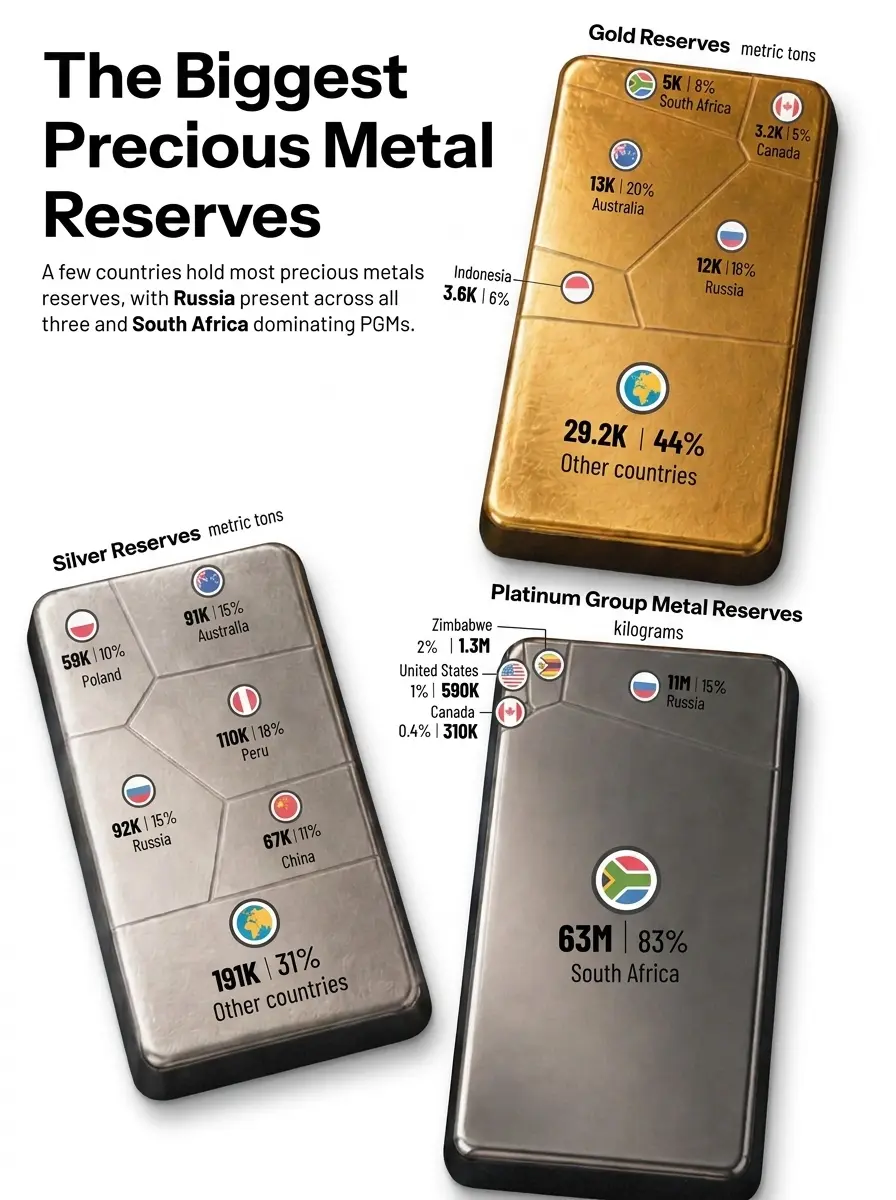
- Some minerals are heavily concentrated in a single country, including platinum-group metals in South Africa (83%) and phosphate in Morocco (69%).
A small group of countries controls the world’s largest reserves of many of the minerals that power modern economies.
This map shows the top reserve-holding country for 18 key minerals, from iron ore and copper to rare earths and cobalt. In several cases, a single nation accounts for an outsized share of global reserves, creating potential supply chain bottlenecks and geopolitical leverage.
Australia Leads Across Multiple Resources
While some countries dominate a single resource, Australia stands out for the breadth of its mineral wealth. It ranks first globally in reserves of five major commodities, giving it one of the most diversified resource bases in the world.
The country ranks first in reserves of gold, uranium, iron ore, zinc, and manganese.
| Mineral | Largest reserves | Share |
|---|---|---|
| Gold | 🇦🇺 Australia | 20% |
| Silver | 🇵🇪 Peru | 18% |
| Copper | 🇨🇱 Chile | 21% |
| Uranium | 🇦🇺 Australia | 28% |
| Diamond | 🇷🇺 Russia | 44% |
| Coal | 🇺🇸 U.S. | 23% |
| Lithium | 🇨🇱 Chile | 25% |
| Iron ore | 🇦🇺 Australia | 31% |
| Bauxite (Aluminum) | 🇬🇳 Guinea | 26% |
| Rare Earth | 🇨🇳 China | 52% |
| Nickel | 🇮🇩 Indonesia | 44% |
| Cobalt | 🇨🇩 DRC | 50% |
| Phosphate | 🇲🇦 Morocco | 69% |
| Graphite | 🇨🇳 China | 32% |
| Zinc | 🇦🇺 Australia | 27% |
| Potash | 🇨🇦 Canada | 45% |
| Manganese | 🇦🇺 Australia | 32% |
| Platinum-Group Metals | 🇿🇦 South Africa | 83% |
Its dominance in iron ore is particularly significant, with 31% of global reserves.
Australia is also home to 28% of the world’s uranium reserves, making it an important player in the future of nuclear energy.
China’s Strategic Resource Position
China leads global reserves of both rare earth elements and graphite, two minerals that sit at the center of modern industrial supply chains.
Together, they support technologies ranging from EV batteries and wind turbines to semiconductors and advanced defense systems.
Rare earths are especially important because they are difficult to substitute in many advanced technologies.
Where Mineral Reserves Are Most Concentrated
Some of the world’s most important mineral reserves are concentrated in just one country. South Africa holds 83% of global platinum-group metal reserves, Morocco controls 69% of phosphate reserves, and the Democratic Republic of Congo accounts for half of global cobalt reserves. This concentration can make global supply chains highly dependent on a small number of producers.
Meanwhile, Indonesia holds 44% of nickel reserves, another key ingredient in electric vehicle batteries.