The global energy story is no longer just about how electricity is generated. It is also about who consumes the fuels behind that power, and where the climate consequences are accelerating fastest.
Taken together, three recent data-driven articles paint a clear picture of today’s energy reality. The first, Ranked: The World’s Biggest Electricity Sources, shows that coal remains the single largest source of electricity worldwide, even as solar and wind grow rapidly. The second, Ranked: Who Uses the World’s Coal?, reveals that coal demand is highly concentrated, with China alone consuming more than half of the world’s total. The third, Ranked: Where Emissions Are Rising Fastest, shows that emissions growth is increasingly concentrated in fast-growing Asian economies such as Vietnam, Indonesia, and India.
These three stories are deeply connected. Electricity generation shapes fuel demand. Coal demand influences emissions. And the regions driving industrial growth and energy consumption are often the same places where carbon output is rising fastest. Together, these visuals help explain one of the biggest challenges of the energy transition: clean energy is expanding, but fossil fuels — especially coal — still play a dominant role in powering economic growth.
Below, we break down each of these themes.
-
The World’s Biggest Electricity Sources
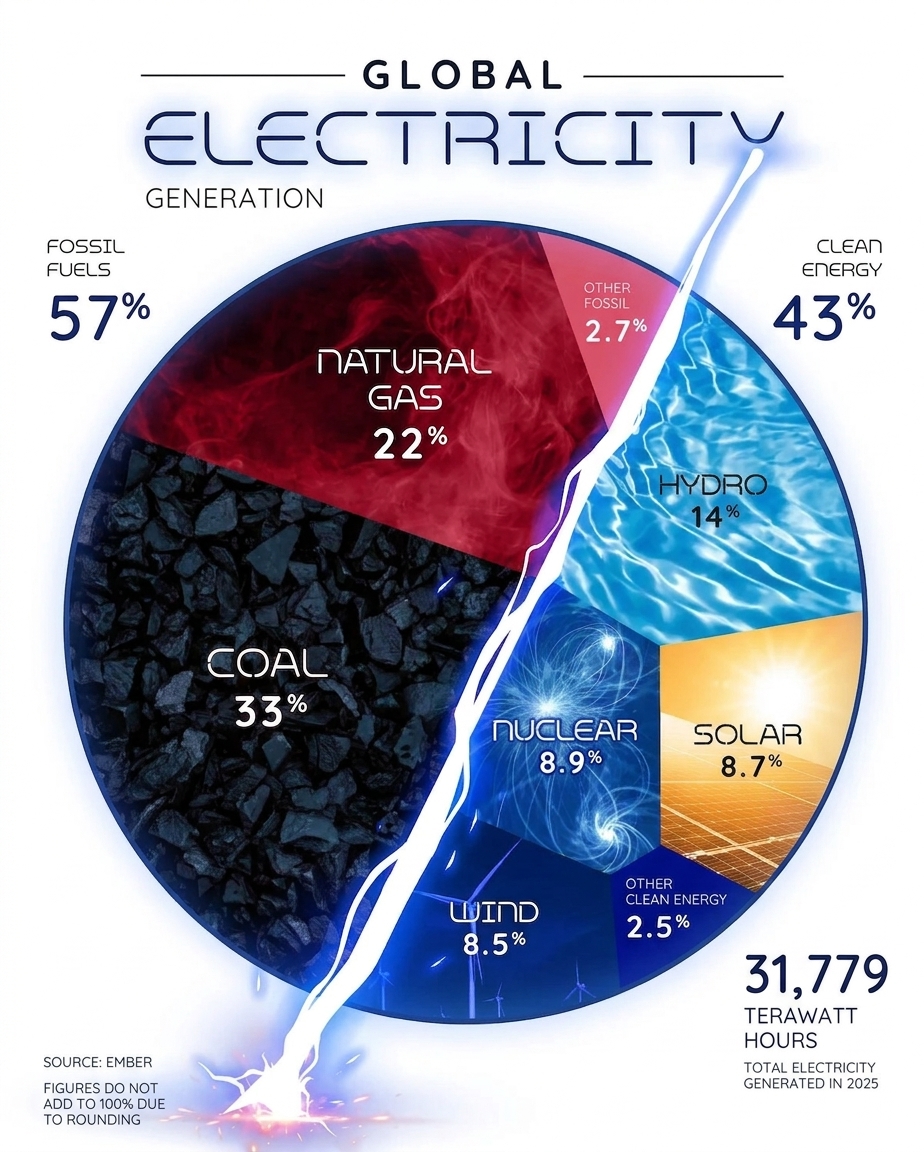
Despite years of momentum behind renewables, coal remains the world’s largest electricity source. That is the central takeaway from Ranked: The World’s Biggest Electricity Sources, which highlights how global power generation is still dominated by fossil fuels.
Coal alone generates roughly one-third of the world’s electricity, making it the single biggest power source on the planet. More broadly, fossil fuels still account for 57% of global electricity generation. At the same time, solar and wind are gaining ground quickly, with each now contributing nearly as much electricity globally as nuclear power.
This matters because the power sector sits at the center of the climate debate. Electricity is the backbone of modern economies, but the sources used to generate it determine whether countries move closer to or further from emissions goals. While renewable growth is encouraging, the global grid is still heavily tied to coal and gas.
Read the original article: Ranked: The World’s Biggest Electricity Sources
-
Who Uses the World’s Coal?
If coal remains the world’s largest electricity source, the next question is obvious: who is using all that coal?
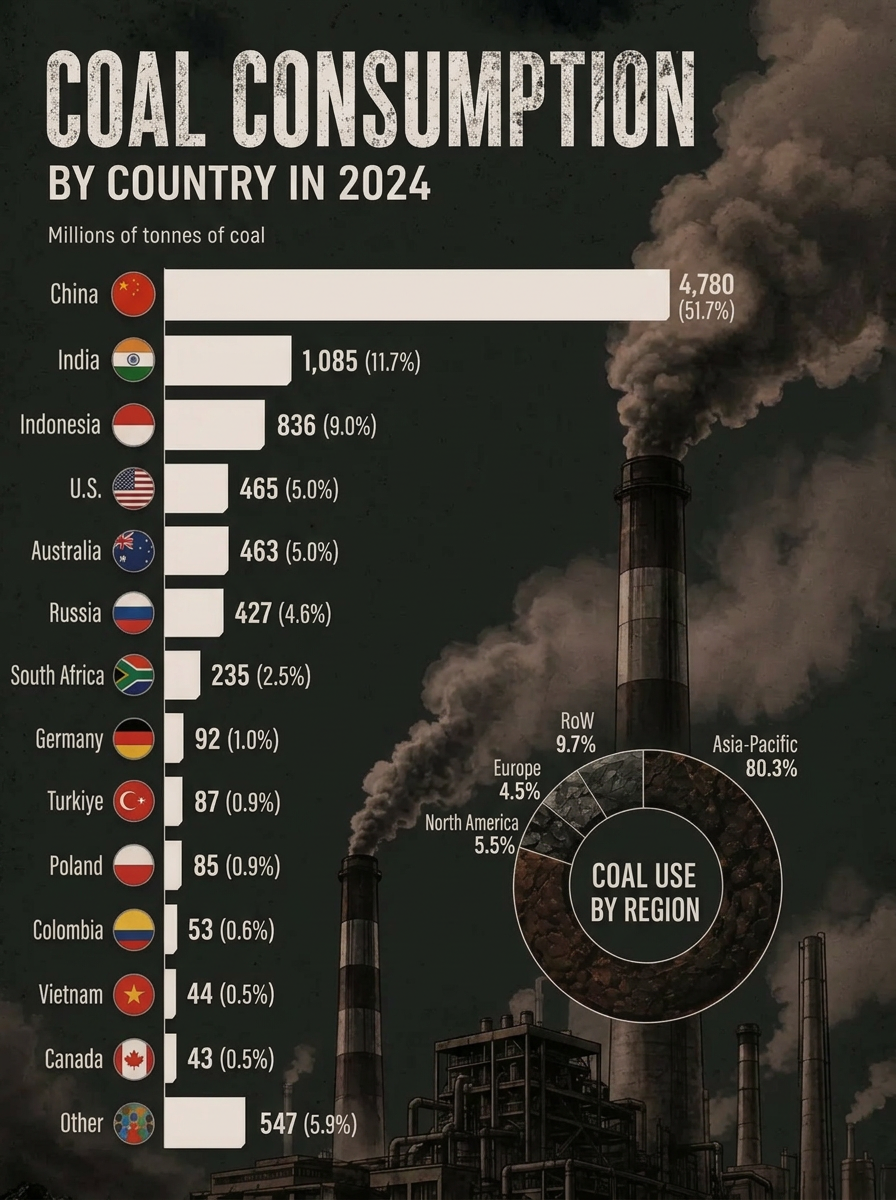
Ranked: Who Uses the World’s Coal? answers that directly. The data shows that coal consumption is more concentrated than any other major fuel. China alone accounts for 51.7% of global coal consumption, using more than all other countries combined. India is a distant second at 11.7%, followed by Indonesia at 9.0%. The U.S. and Australia each contribute about 5% of global demand.
One of the most striking insights is how concentrated coal use really is: the top six countries account for 87% of total global demand. That concentration helps explain why global coal use remains stubbornly high even as many Western economies reduce their dependence on it. Demand growth in a relatively small number of large, fast-growing economies can outweigh declines elsewhere.
This article also reinforces the message from the electricity mix data: coal remains central because it is still deeply embedded in the energy systems of major industrial economies. In many cases, it continues to provide affordable and dependable baseload power while also supporting heavy industries like steel and cement.
Read the original article: Ranked: Who Uses the World’s Coal?
-
Where Emissions Are Rising Fastest
The final piece of the puzzle is emissions.
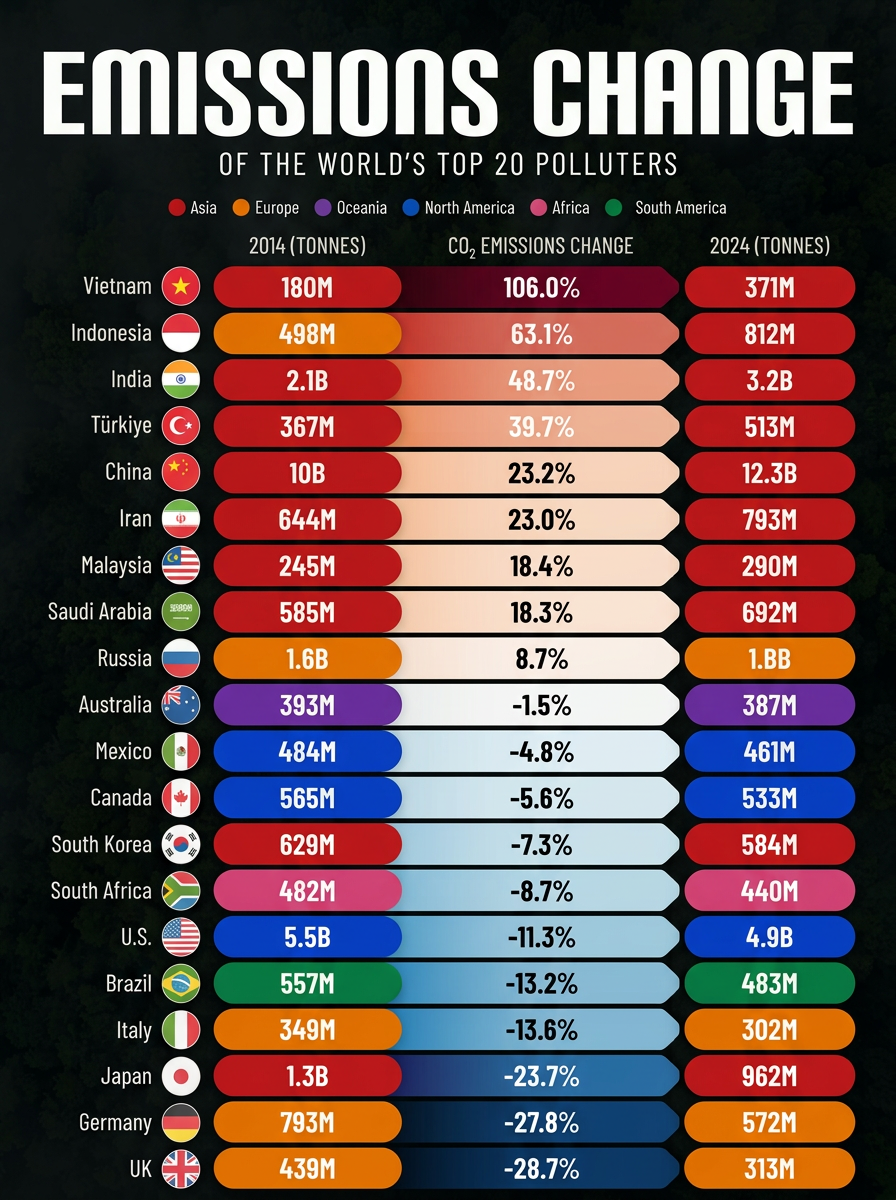
Ranked: Where Emissions Are Rising Fastest shows where carbon dioxide output has grown the most over the last decade, revealing a major regional shift in emissions momentum. Vietnam recorded the fastest emissions growth among major emitters, with CO₂ output rising 106% from 2014 to 2024. Indonesia and India also posted steep increases, reinforcing the idea that emissions growth is increasingly concentrated in fast-growing Asian economies.
At the same time, some advanced economies moved in the opposite direction. The UK, Germany, and Japan each cut emissions by more than 20%, marking some of the largest declines globally.
This contrast is important. It shows that the emissions challenge is no longer just about the world’s largest emitters in absolute terms. It is also about where growth is happening fastest. Countries that are industrializing, urbanizing, and expanding electricity access often face rising energy demand at the same time they are trying to balance affordability, reliability, and decarbonization.
When viewed alongside the first two articles, the trend becomes clearer: coal-heavy electricity systems and concentrated fuel demand are still closely tied to emissions growth, especially in emerging economies where energy demand is climbing quickly.
Read the original article: Ranked: Where Emissions Are Rising Fastest
Conclusion
Together, these three articles tell a single, interconnected story about the modern energy system.
First, coal still plays an outsized role in global electricity generation. Second, coal demand is concentrated in a handful of countries, led overwhelmingly by China. Third, emissions growth is rising fastest in many of the same fast-growing economies where coal remains essential to powering development.
The global transition is clearly underway, with solar and wind scaling rapidly and some countries successfully reducing emissions. But these charts are a reminder that the path forward is uneven. Clean energy growth alone is not yet enough to displace fossil fuels at the speed needed, especially in regions where demand for electricity, industrial output, and economic expansion continues to surge.
For anyone trying to understand the real state of the energy transition, these three visuals offer a valuable starting point: how the world generates electricity, who consumes the most coal, and where emissions are rising fastest.
Referenced Articles