A McDonald’s Big Mac costing R68.30 in South Africa is enough for The Economist to conclude that the rand is 52.04% undervalued against the US dollar. The finding, published as the Big Mac Index marks its 40th anniversary, comes as the local currency held steady after the US Federal Reserve left interest rates unchanged overnight.
The rand traded at around R16.48 against the dollar on Friday morning after markets reacted calmly to the Federal Open Market Committee’s (FOMC) decision to keep its benchmark interest rate at between 3.50% and 3.75%.
Created by The Economist in 1986 as a tongue-in-cheek take on purchasing power parity, the Big Mac Index has evolved into one of the world’s best-known alternative measures of whether currencies are overvalued or undervalued.
In simplistic terms, if the rand traded at the value implied by the Big Mac Index, a Big Mac would effectively cost about half as much in dollar terms – not because McDonald’s would slash prices, but because it illustrates how weak the local currency is.
The index compares the price of McDonald’s signature burger around the world to calculate what exchange rates should be if currencies reflected the same purchasing power. What began as “a playful thought experiment”, The Economist said, has since “amused readers, intrigued currency traders and irritated central banks”.
Despite criticism that a single burger cannot accurately reflect an economy, the publication argues the index remains relevant because a Big Mac incorporates dozens of inputs, from ingredients and labour to rent and utilities, making it a useful proxy for local purchasing power.
While the burger provided the colour, markets remained focused on the Fed. Federal Reserve Chair Kevin Warsh described the US economy as continuing to show resilience despite inflation remaining above the central bank’s 2% target.
“The economy is showing impressive resilience. Even with recent shocks, the trends are positive and reveal solid growth. Inflation remains elevated relative to the Committee’s two percent goal,” Warsh said after the meeting.
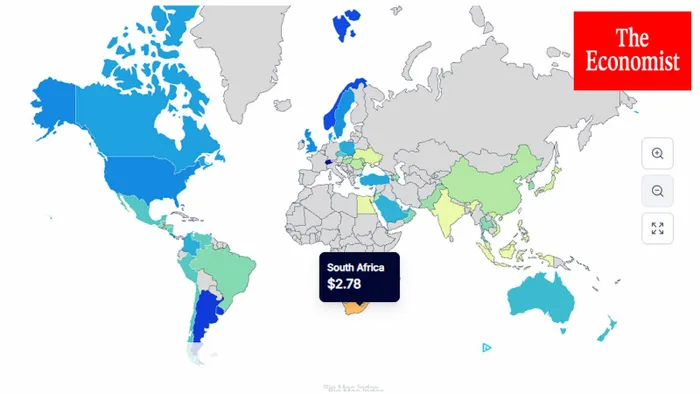
A Big Mac should cost $2.78 in dollar terms.
Image: The Economist
Investec chief economist Annabel Bishop said the Fed’s decision had little immediate impact on the rand. “The rand has seen little impact… with flat US interest rates expected, and unlikely to cause rand weakness as a US interest rate hiking cycle typically does,” she said.
Bishop noted that while the Fed left rates unchanged for a fifth consecutive meeting, policymakers had deliberately avoided providing forward guidance, choosing instead to respond to incoming economic data as uncertainty remained elevated.
Andre Cilliers, currency strategist at TreasuryONE, said the broader US dollar had steadied after Wednesday’s post-Fed sell-off, helping the rand maintain its recent gains.
“Against this backdrop, the rand is holding onto its recent gains, trading little changed around R16.50,” he said earlier this morning.”
The currency came dangerously close to R17 the day after the South African Reserve Bank announced it was holding rates, a move that was unexpected and deterred international investors.
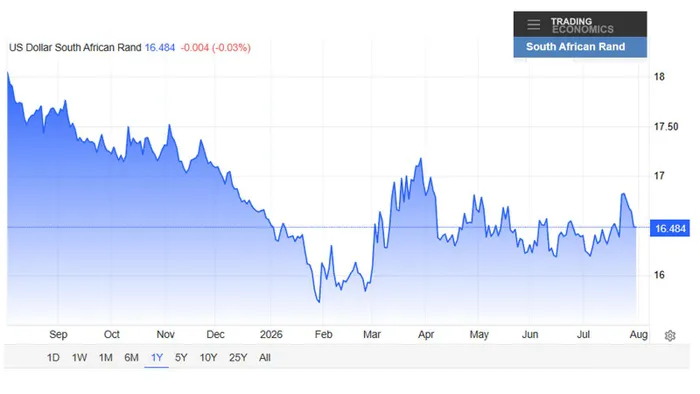
Cilliers attributed the currency’s resilience to softer oil prices and improving global risk appetite, although weaker gold prices and lingering domestic policy concerns were limiting further gains. “The rand looks set to stay range-bound in the near term.”
Four decades after its launch, The Economist argues the Big Mac Index remains a surprisingly effective reminder that exchange rates can drift far from underlying purchasing power, even as traders continue to focus on interest rates, inflation and geopolitics.
“The Big Mac, though a single product, has over 60 distinct ingredients, from beef to xanthan gum. It also draws on labour and property markets wherever it is made and served.
“The Big Mac index’s predictive record is admittedly mixed. But it showed correctly, for example, that the euro was overvalued when it came into being in 1999,” the publication said.
Source: IOL – Nicola Mawson